dog stiff the day after a long walk: normal soreness or worth acting on.
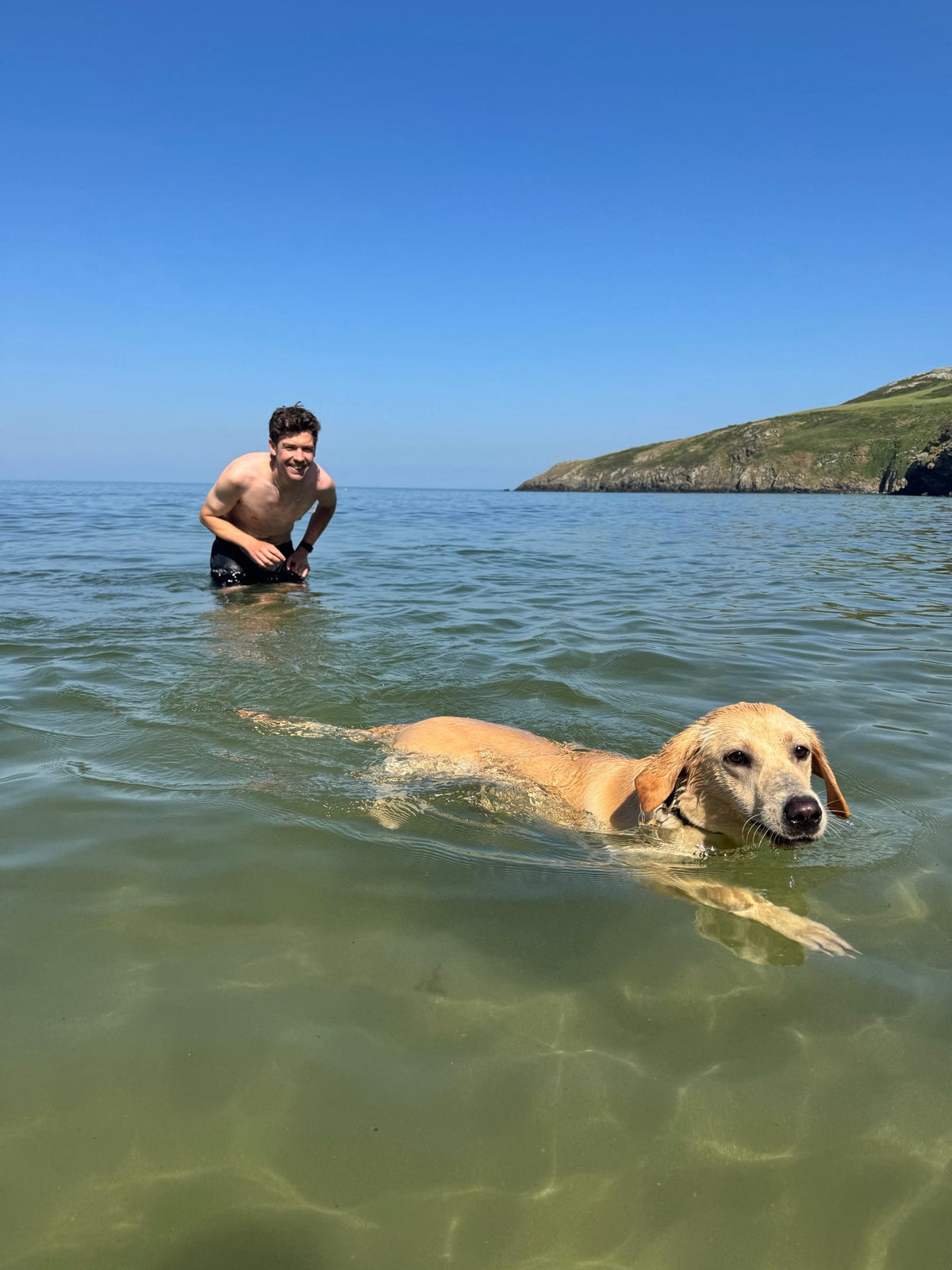
if your dog is stiff the day after a long walk, and it's a one-off after a genuinely bigger day than usual, it's most often normal post-exertion soreness. much like us after the first proper hike of the year, dogs feel unaccustomed effort in their muscles a day later. published canine rehabilitation guidance describes it setting in a day or two after exercise and resolving by about three days, and your dog is otherwise bright, eating well and putting weight on all four legs.
the thing worth acting on isn't the one big day. it's a pattern: next-day stiffness that turns up after ordinary walks too, stiffness after lying down that "warms out" once your dog gets going, or a dog who's quietly slowing down and lagging behind on walks they used to lead. that pattern is a vet conversation, not a supplement decision - and the rest of this guide is about telling the two apart.
when to see your vet.
book a vet, and don't wait on a supplement, if your dog can't put a leg down or is holding it up, cries out or flinches when a joint is touched, or has obvious swelling or heat around a joint. the same goes if stiffness comes with being off food, unusually flat, or feverish, or if soreness after a walk hasn't eased by about three days. sudden, severe or non-weight-bearing lameness is a same-day call. dogs are good at hiding discomfort, so if something feels off, get it looked at - early is always better than late.
what's actually going on in the joint
two different things cause next-day stiffness, and they behave differently.
the first is in the muscles. unaccustomed effort, like a longer or hillier walk than your dog is trained for, causes tiny amounts of muscle micro-damage - the same delayed soreness people feel a day or two after a hard session. it peaks and then fades, and gentle movement helps rather than hurts.
the second is in the joint itself. joints are lubricated by synovial fluid, which behaves a bit like non-drip paint: thick and stiff when it sits still, thinner and more slippery once it's stirred. after a long rest the fluid is at its most sluggish, so the first few minutes of movement feel stiff, then loosen off. that's why the classic description is stiffness that's worse after resting and eases once your dog is up and about (pdsa). a one-off is unremarkable. the same pattern, day after day, is the early sign worth noticing.
normal soreness versus a pattern worth acting on
| usually normal soreness | worth a vet conversation |
|---|---|
| follows a genuinely bigger day than usual | turns up after ordinary walks too |
| a one-off, or very occasional | a repeating pattern over weeks |
| resolves by about three days | lingers, or keeps coming back |
| weight-bearing on all four legs | limping, holding a leg up, or bunny-hopping |
| bright, eating, keen to move | slowing down, lagging, hesitating at stairs, car or sofa |
| loosens up quickly once moving | stiff after every rest, or gradually getting worse |
one honest caveat: this is a guide to noticing, not diagnosing. only your vet can examine the joint and tell you what's behind a pattern. your job at home is to spot the pattern early and take it to them.
the three-day rule
for ordinary post-walk soreness, a simple rule helps: give it about 48 hours. keep your dog moving gently with short, slow lead walks for toilet breaks, rather than shutting them in a crate. gentle movement keeps that synovial fluid circulating and helps muscles recover, whereas complete rest and, at the other extreme, another big walk are both worse than an easy potter around the garden.
if your dog is back to normal within a day or two, that was soreness doing what soreness does. if it hasn't settled by about three days, or it settles and then returns on the very next ordinary walk, stop guessing and see your vet.
building distance without the next-day payback
most next-day stiffness in otherwise-healthy dogs is a training-load problem: the classic weekend warrior who mooches about all week then does a three-hour hike on sunday. dogs, like us, cope far better with consistent exercise than with occasional heroics (akc).
a few things that help:
- build up gradually, adding a little to walk length or intensity each week rather than doubling it because the weather turned nice.
- favour little-and-often over one enormous weekend outing. a steady daily walk beats a saturday marathon.
- warm up and cool down with a few minutes of easy walking at each end, rather than launching straight into fetch.
- notice the terrain. hills, sand, deep mud and long games of fetch load joints far harder than the same distance on the flat.
a track-at-home checklist
if you're not sure whether you're seeing a one-off or a pattern, spend two or three weeks keeping a simple note. it turns a vague worry into something your vet can actually use:
- which mornings your dog seems stiff, and how long it takes to loosen off.
- what the day before looked like - distance, terrain, and how hard they went.
- whether they're hesitating at stairs, the car boot or the sofa.
- whether they're keeping pace on walks or dropping behind.
- any licking at one spot, or a leg they seem to favour.
a short phone video of your dog moving on a stiff morning is worth a lot in the consulting room, because dogs have an annoying habit of trotting in perfectly the moment they smell a vet.
where daily joint support fits, and where it doesn't
first, the honest bit: a supplement is not a treatment, and it won't fix a limp, a sudden lameness or a dog who's in pain. those are vet problems. daily joint support is for the other dog - the healthy, gradually-stiffening older dog whose vet is happy there's nothing that needs treating, where the goal is simply to support normal joint function over the long haul.
two ingredients have a genuine evidence base worth knowing about. green-lipped mussel is one. it's studied for its role in supporting normal joint function, and a veterinary review of orally given joint health products rated the canine evidence behind it as moderate - which, in this category, makes it one of the better-supported ingredients going (javma). there's human research too (pmc), but it was done in people being treated for a diagnosed joint condition, which is a different question from daily support for a healthy dog - we'd rather say that plainly than borrow its results. our green-lipped mussel dosage guide goes deeper, and green-lipped mussel versus glucosamine compares it to the old default.
the other is omega-3, meaning epa and dha from fish. in dogs, the controlled trial evidence points to a role in supporting normal joint function - with the honest footnote that the best-known trial was run in dogs already diagnosed with joint disease and under veterinary care, not in healthy dogs (javma). the same trial is a useful lesson in patience: dogs were assessed over 90 days, and the change the researchers reported was measured at the end of that period, not in the first fortnight. that slow timescale is the norm, not the exception - our guide on how long joint supplements take to work sets honest week-by-week expectations.
whatever you choose, the numbers are what matter: a daily dose has to actually contain a meaningful amount of the active, not a sprinkle for the label. we don't quote our own figures here because our final doses are being confirmed with our manufacturer - once they're set, they'll be printed on the label and shown on our proof page. and a chew supports; it doesn't replace vet care, weight management or sensible exercise, which is roughly the point of our all-in-one supplements guide.
the honest bottom line
stiff the morning after one big walk, easing within a day, dog otherwise happy: almost certainly normal soreness, and a nudge to build distance more gradually. stiff after ordinary walks, stiff after every rest, slowing down over weeks: that's the early sign worth taking to your vet, sooner rather than later. daily support has a place for the gradually-stiffening dog once your vet has had a look, but it earns that place by supporting normal joint function, not by fixing anything.
quick answers.
is it normal for my dog to be stiff the day after a long walk?
a one-off is usually normal. after a genuinely bigger or hillier walk than your dog is used to, next-day muscle soreness is common and typically sets in a day or two and resolves by about three days. the thing to watch isn't the single big day - it's stiffness that starts turning up after ordinary walks, or that returns week after week.
my dog is stiff after lying down but then walks fine - is that ok?
stiffness after resting that loosens once your dog gets moving is one of the most commonly noticed early joint changes, especially in older dogs (pdsa). as a one-off it's unremarkable. as a repeating pattern, stiff after every rest and warming out each time, it's worth mentioning to your vet, who can examine the joint properly rather than guessing from the sofa.
how long should soreness after a walk last before i worry?
a useful rule is about 48 hours. keep your dog moving gently with short, slow lead walks rather than crate rest, and most ordinary soreness settles within a day or two. if it hasn't eased by about three days, keeps returning on normal walks, or comes with limping or being off food, see your vet.
will a joint supplement help a dog that's stiff after walks?
not as a treatment - a supplement won't fix a limp or a dog in pain, and those need a vet. for a healthy, gradually-stiffening dog whose vet is happy, daily support can help maintain normal joint function. green-lipped mussel and omega-3 have real evidence behind them, but both work slowly, over weeks to months, not overnight.
how do i stop my dog being sore after long walks?
build distance gradually rather than saving it all for the weekend. increase walk length or intensity a little at a time rather than in big jumps, keep exercise consistent through the week, add a few minutes of easy walking to warm up and cool down, and go easier on hills, deep mud and long fetch sessions, which load joints hardest.
sources.
- pdsa - limping and stiffness in dogs
- canine arthritis resources and education - therapeutic exercise key principles
- akc - canine athlete conditioning and fitness basics
- pmc - green-lipped mussel extract supplementation in treatment of osteoarthritis: a systematic review
- javma - orally administered joint health products in dogs and cats (oke 2009)
- javma - fish oil omega-3 fatty acids and weight bearing in dogs with osteoarthritis (roush 2010)
one chew, once a day.
joints, coat, tummy and everyday immune support in a single daily cold-pressed chew - doses printed on the label.
join the waitlist.